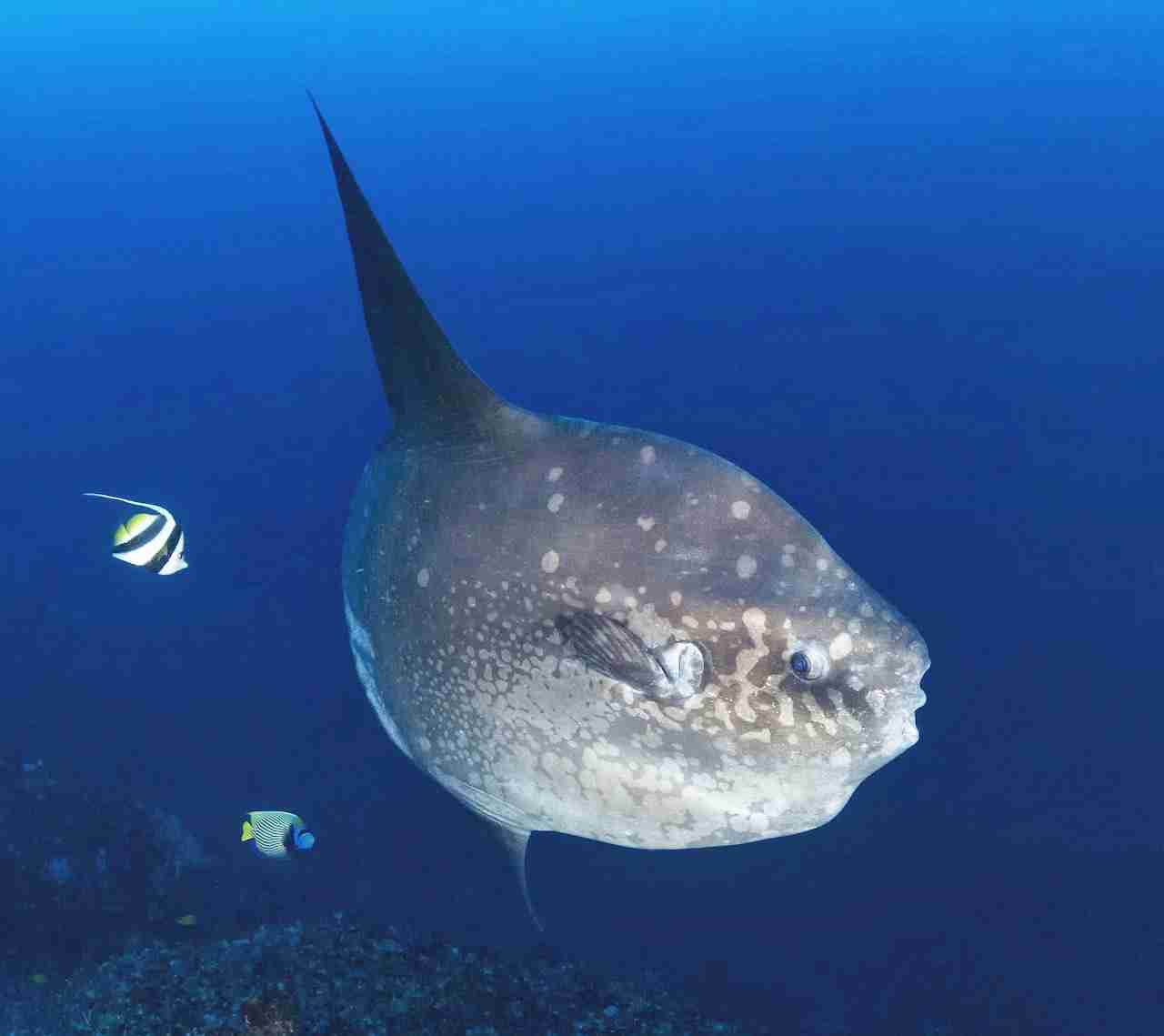
There’s a moment that every diver who’s been to Crystal Bay will remember: you’re at 20 metres, hugging the reef, when something shifts in your peripheral vision. Out of the deep blue, a shape materialises. Flat, enormous and unhurried. A Giant Sunfish rises slowly toward the cleaning station.
That moment is why divers fly to Nusa Penida. This guide tells you exactly when to come, where to look, and what to expect when you get here.
What Is a Mola? (And Why Divers Fly Halfway Around the World to See One)
The Mola Ramsayi, also called the Giant Sunfish, is the world’s heaviest bony fish by some way. They can reach 3 metres across with the largest ever found weighing an incredible 2,744 kg. A massive head, two fins, and a peculiar frilly tail called a clavus. They are closely related to the better known Mola Mola (Ocean Sunfish) but the Ramsayi gets bigger, hence the name Giant!
Mola Ramsayi spend most of their lives in deep water, well below diveable depth. What makes Nusa Penida different is geography. Cold upwellings from the Indian Ocean funnel through the Lombok Strait and push deep, nutrient-rich water toward the surface around the island’s dive sites. The mola follow this thermocline up into shallower water to visit cleaning stations on the reef, where small fish remove parasites from their enormous skin. Of course they are also known to relax at the surface sunbathing, hence the common English name “Sunfish” (in German they are known as Moonfish because of their appearance).
For a few months every year, at a handful of sites around this small island off Bali’s southeast coast, you can drop into the blue and watch them rise out of the deep toward you.
When Is Mola Season in Nusa Penida?
The simple answer: July to November, with the peak running August through October.
Here’s what each month realistically looks like:
- July. The season begins. Sightings become regular as water temperatures start to drop. Not peak frequency yet, but the sites are quieter than in August if you want to avoid the crowds.
- August to October. Peak season. The thermocline sits reliably in the 18–22°C range, sightings are most frequent, and your chances of seeing them are at their highest.
- November. The tail (or clavus!) end of season. Still possible, still very much worth the trip, but frequency drops and timing becomes less predictable.
- December to June. Rare but not impossible. The thermocline retreats to depths beyond where mola surface to clean. Nusa Penida is still outstanding diving year-round, with mantas and other reef life here constantly, but if mola are the main reason for your trip, plan for the season window. Having said that, we guess they don’t travel too far. In the last couple of years we’ve had a random week or two early in the year where the temperature unexpectedly drops, and the mola have been appearing in almost high-season numbers!
A note on water temperature: when the mola are around, the water is cold. Not “grab a light wetsuit” cold. Genuinely cold, 18–22°C at depth after surface temperatures sitting in the mid to high 20s. When you hit that thermocline, it’s a physical jolt. On a really cold day it can get even lower. We’ve seen as low as 13°C, but that’s very unusual. We’ll cover what to wear below.
Planning a mola trip? Staying on Nusa Penida gives you the best chance of multiple sightings. Early dives before the day-trip boats arrive, multiple shots across the week. Check our Penida dive packages
Where to See Mola Around Nusa Penida

Crystal Bay
Crystal Bay is the name everyone knows, and for good reason. The site has a well-established cleaning station where Mola Ramsayi reliably appear during season. Currents here can be strong, and that’s part of what drives the cold upwelling that brings the fish up in the first place. Visibility sometimes drops when the thermocline pushes through. That might sound like a problem but it’s not. The reduced visibility and the cold water are signs the conditions are right. The mola don’t come up to a clean, calm, 30-metre visibility site. They come up because the cold water is there, and the cleaner fish are waiting.
There are a couple of good spots to hang out and look for them, known mainly as the first corner and the second corner. You can probably work out where the names come from. Which one (if either) you can get to depends on current and ability. Normally we drop in nearby, work to the best spot for conditions and hang out for a while waiting to see what comes. Even when we work back into the bay there are still chances to see them on the wall. We even occasionally get them cruising around the sandy bay at 5 m while we’re on our safety stop!
Other Sites
Mola sightings aren’t limited to Crystal Bay. Most sites around the island can produce encounters, and some are considerably less crowded. There are sites in the main channel with good cleaning stations but they have to be timed right due to current. Toyapakeh is probably the most famous. As diving pressure in Penida has increased, the mola have spread out more, so they are now reasonably often seen at the northern drift sites. Close to our centre on the east coast we know a couple of good cleaning stations, and as this side is far less dived the encounters tend to be better. Another spot is actually Manta Point, where there is a cleaning station on a 30 m ridge to the west side, so you can tick both the manta and mola boxes in a single dive!
On depth: Most productive mola encounters happen in the 15–30 metre range during cleaning station visits, though they dive much deeper between stations. Advanced Open Water limits cover the key depth band, but see the certification notes below because depth isn’t the only consideration here.
What You Need to Know Before Your Mola Dive
Certification
Minimum Open Water certification required (although yes, we’ve had Discover Scuba Divers lucky enough to see them at 5 m in Crystal Bay as outlined above). That said, mola spend more time deeper, so Advanced Open Water is better to allow you to go to 30 m.
Fitness
These aren’t gentle drift dives. You’ll work against current at times, hold position in the water column, and manage buoyancy at depth. Reasonable fitness matters. If you’ve been diving regularly, you’ll be fine. If this is your first dive in two years, a few shallower warm-up dives first is a good idea.
Exposure Protection
This is the thing divers consistently underestimate, especially those coming from warmer Bali dive sites.
The surface around Bali runs 28–30°C most of the year, and is still around that in the north of Penida during the mola months. The southern sites are normally around 24°C on the surface at mola time. When you drop through the thermocline at Crystal Bay, the temperature can fall to 18°C or lower within a few metres. That’s a six-degree shock and feels like ice if you’re in a 3 mm tropical wetsuit.
Bring a 5 mm wetsuit. A hood makes a significant difference. If you’re combining a Penida mola trip with warmer reef diving elsewhere in Bali, pack for both, or check with us about rental options on-island. All of our suits in Penida are full-length 5 mm for this reason.
Code of Conduct
Mola Ramsayi are large, slow-moving, and surprisingly easy to disturb, so the rules are the same as for manta encounters. Don’t chase them. Don’t approach from above or cut off their path to the ocean. Maintain a respectful distance and let the fish come to you.
This isn’t just courtesy. If you chase a mola, it dives back into the deep and your encounter is over. If you stay still and calm, it may spend minutes at the cleaning station, close enough to see its eye, watch the cleaner fish working, and actually take in what you’re looking at. Big and slow they may look, but if you swim directly at one at high speed, it can swim faster than you. And it will. So your encounter will consist of watching a mola’s butt vanish into the deep, which is not so great.
We go through the code of conduct (and show a brief video) in the centre before we go on dives where we are looking for mola or manta. It’s worth paying attention.
Realistic Expectations
No honest operator guarantees mola sightings. We dive in the ocean, not a zoo! What we can tell you: during peak season, with multiple dives over several days, your chances are genuinely good. Staying on-island and diving early and often is how you stack the odds in your favour.

Two Fish Nusa Penida runs mola dives daily during season with small groups, maximum 4 divers per guide, and guides who know exactly where to look.
See day trip options | Stay on-island for the full experience
Day Trips or Staying On-Island?

Both work. Which one suits you depends on how much time you have.
If you have a day
Our Sanur day trips get you to Crystal Bay and back with three dives and all transfers sorted. It’s a 45-minute fast boat each way, you’ll be diving by mid-morning, and you’re back in Sanur by late afternoon. For divers based in south Bali who want a shot at mola without rearranging their whole trip, this is a solid option.
- Single day trip: IDR 3,600,000 for 3 dives from Sanur
- Popular package: IDR 5,120,000 pp, 3 Penida + 2 Padang Bai (5 dives)
- Best-of-Bali: IDR 6,430,000 pp, adds Tulamben wreck (7 dives total)
If you have more than a day
Staying on Nusa Penida opens up a different experience. You’re in the water early, before the day-trip boats arrive, and the sites are noticeably quieter. Afternoon dives are possible. The north and east coast sites that aren’t reachable on a day trip are yours, including those east coast cleaning stations where the mola encounters tend to be better because the sites are far less dived.
The maths is simple: over a few days on-island you might do 8–12 dives. That’s 8–12 chances at mola, compared to two on a day trip. More dives, more chances.
- Stay+dive packages: from IDR 4,325,000 for 3 nights / 4 dives, including accommodation with our Penida partners (Favourit Villas, Alana Hotel, La Roja Bungalows). Two dives per day are IDR 1,825,000–1,925,000.
Want help choosing?
Tell us your dates and experience level and we will put together the right package.
Beyond Mola: What Else to See in Nusa Penida
Come for the mola, stay for everything else!
Manta rays
Year-round at Manta Point and Manta Bay, with numbers varying by season. As long as conditions allow us to get to these sites the odds are good. Well over 90% chance of seeing these incredible creatures.
Sharks and turtles
We often see smaller sharks such as bamboo sharks but have fairly frequent sightings of larger species too: threshers, hammerheads, whale sharks and others all turn up around the island during the year. Green and hawksbill sea turtles are common enough that divers stop pointing them out after the first day.
The north coast drift dives
This is what catches people off guard. Five consecutive sites (Ped, SD Point, Sental, Buyuk, Tugu Drop Off) running along a coral plateau with some of the healthiest reef in Bali. You drift with the current over hard and soft corals in genuinely excellent condition, schools of barracuda and trevally moving through, turtles on nearly every dive. On a good day, it looks like a fish carpet. Most of these sites see a fraction of the traffic that Crystal Bay and Manta Point get.
The macro life nobody expects
Penida has a reputation as a big-stuff destination, but the small stuff is genuinely there too. Frogfish, ghost pipefish, orangutan crabs, nudibranchs, especially on the east coast sites near our centre. At dusk, mandarin fish come out if you know where to look. Divers who’ve only heard about mola and mantas don’t expect this side of the island at all.
The reef itself
Penida’s coral diversity is excellent, particularly on the north coast where the reef health is among the best you’ll find anywhere in Bali. Even on a dive where the megafauna doesn’t show up, the reef is genuinely worth being there for.
Wild cards
Snaggletooth sharks cruising the outer reef, eagle rays cruising past in the blue, and occasional sightings that make your logbook entry read like fiction. Threshers, whale sharks, even oceanic mantas have turned up here. None of these are guaranteed, but Penida’s nutrient-rich currents mean you never quite know what’s going to appear next.
The point: even on a day when the mola don’t come to the cleaning station (and it does happen) you’re not going home without a story. The wildlife here doesn’t rest between mola sightings.
If you’re building a longer Indonesia trip, the contrast between Nusa Penida’s megafauna (big animals in open blue water) and Amed’s macro world (black sand and shipwrecks) is one of the best combinations in diving. Completely different experiences and both top quality.
Combine Nusa Penida’s megafauna with Lembeh’s world-famous macro diving for the ultimate Indonesia trip. Explore our multi-location safari options
How to Book Your Mola Diving Trip
When to enquire
Peak season (August to October) fills up. If you’re planning a trip, reach out at least 2–3 months ahead. Ideally April or May for a July or August trip. Leaving it to June for an August booking is possible but risky.
What to tell us
Your dates, certification level, number of divers, and whether you’re thinking day trips from Sanur or staying on Penida. Everything else we can work out from there.
How to reach us
Drop us a message and we’ll get back to you with a personalised quote and answers to your specific questions directly from the team on the ground.
We’ve been running mola dives for years. Whatever you’re wondering (conditions this week, whether your certification is suitable, the honest chances of a sighting in November versus September) just ask. That’s what we’re here for.

Ready to book your mola diving trip?
Drop us a message with your dates and we will sort out the rest.